Appliance Leak Water Damage in San Gabriel Homes
A washer hose, dishwasher drain or refrigerator supply tube can leak behind the appliance for a long time. Crews in San Gabriel dry the floor, cabinets and walls, and check the unit below.
(888) 578-6508Report a leak near an appliance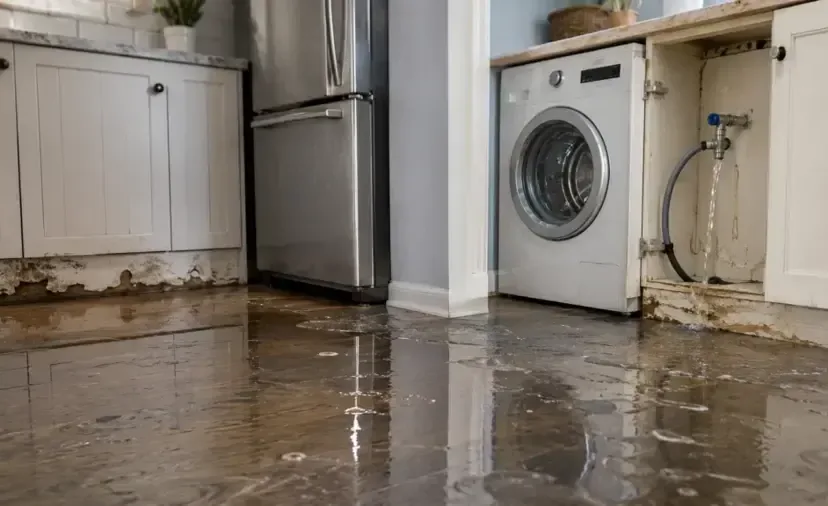
First steps for appliance and supply hose leaks
Close the valve
Shut the supply valve or the main valve, unplug the machine and move it only if the floor is safe.
Mop the standing water
Remove puddles with towels and a wet vacuum, and open cabinet doors for airflow.
Warn the unit below
In a shared building, tell the neighbor below to check the ceiling.
Photograph and call
Photograph the failed part and the wet areas, then call the drying crew.
How appliance and supply hose leaks is handled
Appliance leaks are quiet. A cracked washer hose or a loose dishwasher connection can drip behind the machine for weeks, and the first sign is often a soft floor or a stain on the ceiling of the unit below.
Rapid local response
Active water is treated as urgent at any hour, so the extraction crew starts while the water is still on the surface.
IICRC S500 drying standard
Moisture mapping comes first, then extraction, air movers and LGR dehumidifiers sized to the class of loss.
Claim-ready documentation
The mitigation team keeps a moisture map, daily psychrometric logs and timestamped photos for the adjuster.
Valley water know-how
Slab floors, copper under concrete, hard water and storm runoff with nowhere to drain shape each drying plan.
What does appliance and supply hose leaks cost in San Gabriel, CA?
A laundry room or one area usually costs $800 to $2,000, and a kitchen with wet cabinets runs $2,000 to $4,000. A long-running leak that reached several rooms and walls costs $4,000 to $5,500 or more.
Laundry room or one area
$800 to $2,000- Water extracted and dried
- Toe kicks off for airflow
- Several days of drying
Kitchen with cabinets
$2,000 to $4,000- Water under cabinets and floor
- Vinyl or laminate lifted
- Cabinet bases dried
Long-running leak
$4,000 to $5,500+- Several rooms and walls wet
- Swollen cabinets and drywall out
- Extended drying with records
Ranges are typical, not a quote: the water category, square footage, material class and how fast drying started move the number most. The water damage cost calculator gives a closer planning range.
Appliance and Supply Hose Leaks, step by step
- 1
Find the wet extent
A meter and thermal camera map the water under the appliance and into cabinets and walls.
- 2
Extract and open up
Water is extracted, toe kicks come off and wet flooring is lifted.
- 3
Dry cabinets and floor
Fans and a dehumidifier dry the cabinet base, subfloor and wall bottoms.
- 4
Verify and document
Readings confirm everything is dry, and the owner gets photos and logs.
Where these leaks hide
The water follows gravity and hides in places that stay out of sight:
- Behind and beneath a washer or dishwasher
- Under a sink and inside the cabinet base
- Under a refrigerator, in the floor and subfloor
- Inside the wall behind a supply valve
Renters, neighbors and shared floors
With 6,261 renter-occupied homes in the city, many appliance leaks involve a landlord or a neighbor. Water that gets under flooring or into a wall can reach the ceiling of the unit below, so the crew checks adjoining spaces and keeps records both parties can use. A stained ceiling below follows ceiling leak steps.
Drying cabinets and flooring
Toe kicks come off so air can reach the cabinet base, and swollen cabinet boards that will not recover are removed. Vinyl and laminate are lifted where water got under them, while hard surfaces may be dried in place. Air movers and a dehumidifier run until readings on the cabinets, the floor and the wall bottoms all test dry.
Fixing the hose and filing the claim
The hose or connection is replaced by a plumber or the owner before drying begins, and the old part is worth keeping for the adjuster. Photos, readings and the list of removed materials go into the file, along with water extraction notes.
Appliance and supply hose leaks coverage and nearby areas
Appliance leaks are cleaned up in kitchens and laundry rooms across the 91775, 91776 and 91778 ZIP codes, from single homes to apartment buildings where one unit's leak reaches the next.
The same service nearby: appliance and supply hose leaks in Sun Valley, San Marino, Alhambra.
Water damage restoration in San Gabriel · every town covered
Related water damage services in San Gabriel
Appliance and Supply Hose Leaks: common questions
Which appliances leak the most?
Washing machine hoses, dishwasher connections and refrigerator supply tubes are common sources because they stay under pressure and sit out of sight.
Can cabinets be saved after a leak?
If they are solid wood and caught early, often yes. Swollen boards that crumble or lose their shape are usually replaced.
What if the leak damaged the apartment below?
The crew documents the damage at the source, and the tenant or owner below should be told right away. Both sides keep photos and readings.
Should the washing machine hose be replaced after a leak?
Yes, with a braided hose and a fresh connection. A plumber or the owner can swap it, and the old hose is worth keeping as evidence.
How many days does a wet kitchen need to dry?
A single area often needs two to four days, while cabinets and walls that took on water need longer. The daily readings decide when the equipment leaves.
Does insurance pay for a washer hose leak?
Sudden hose failures are often covered for the water damage, though not for the hose. A slow leak that went unnoticed may be limited, so prompt photos matter.
Dry the cabinets and floor
Crews extract the water, open toe kicks, lift wet flooring and dry cabinet bases and walls until readings are normal.