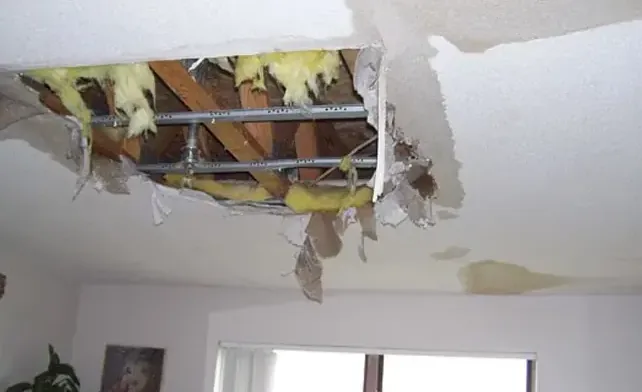
In a building where families live above and below each other, a leak rarely stays in one apartment. A brown stain on a ceiling is usually the end of a trail that starts in the unit overhead.
Key takeaways
- San Gabriel has about 3,541 housing units in buildings of five or more units, plus 1,672 attached single family homes.
- Renters live in 6,261 of the city's 12,612 occupied homes, so many households depend on a shared building.
- Water from a unit above travels through the floor and ceiling layers, light fixtures and wall cavities.
- A tenant should tell the owner or manager right away, photograph the damage and keep belongings out from under the stain.
- Drywall is opened where it is soaked, and drying continues until readings match dry areas.
Why shared walls matter in San Gabriel
American Community Survey estimates for 2020 to 2024 count 13,818 housing units in San Gabriel, of which 12,612 are occupied. About 3,541 housing units are in buildings of five or more units.
The city also has 7,951 detached single family homes and 1,672 attached single family homes. Of the occupied homes, 6,351 are owner occupied and 6,261 are renter occupied.
A leak in this kind of housing involves people who may not know each other, so clear communication is part of the fix. Quick notice to the owner or manager matters more than who is at fault.
That mix means a ceiling leak is not a rare event. Any building with bathrooms and kitchens stacked on top of each other can send water down to the next home.
- Many residents share ceilings, floors and plumbing walls with neighbors.
- Attached homes can share a wall even when each has its own entrance.
- Owners and managers often control the source of a leak that tenants feel.
How water travels from the unit above
Through the ceiling and light fixtures
Water from a bathroom, kitchen or supply pipe above soaks the floor layers and finds the ceiling below. It gathers at recessed lights, vents and seams, where drips appear first.
That is why a leak that began in one corner can show up as a stain across the room.
Bathrooms and kitchens sit directly above many ceilings, which is why a failed supply pipe, a tub overflow or a dishwasher leak is a common cause.
Down wall cavities
Water that does not stop at the ceiling travels down the inside of walls. It reaches baseboards and the floor, sometimes on the opposite side of the room from the stain.
Into the units on either side
Shared walls let moisture move sideways too. A neighbor may notice damp paint or a musty smell days after the first stain appears.
First steps for a tenant
Speed matters because wet drywall and insulation weaken the longer they stay damp. The goal is to tell the right person and protect belongings.
A tenant is not expected to open the ceiling or find the source. The job is to report it, protect belongings and keep a record.
- Tell the owner or building manager right away, in writing if possible.
- Move furniture, electronics and bedding away from the stain.
- Do not poke or press a bulging ceiling.
- Turn off power to any wet light fixture or ceiling fan.
- Photograph the stain, the drips and any damaged belongings with the date.
First steps for an owner or manager
The source has to be found and stopped before drying can work. A building owner or manager is often the only person who can reach the unit above.
Owners can read the main ceiling leak water damage page for the full process crews follow. The same steps apply to any building.
- Shut off the supply to the leaking fixture or the unit above.
- Open access to the affected units, including neighbors on either side.
- Call a plumber for the repair and a crew for the water.
- Keep the contact details of every affected household in one place.
How a ceiling and wall cavity are dried
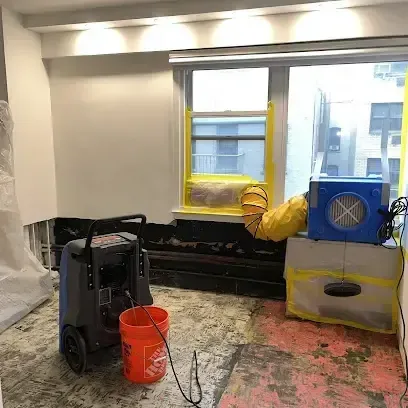
The crew starts with moisture readings across the ceiling, the walls and the floor. Standing water is pulled out first, which is the work of water extraction.
Where drywall is soaked or sagging, it is cut open so the joist bays and wall cavities can dry. A ceiling leak water damage job usually also includes wet insulation, which is removed and replaced.
Drying equipment runs until the readings match unaffected areas. Painting a stain without checking readings can trap moisture behind the paint.
The crew also checks the floor of the unit above if it can be reached, since wet subfloor can keep feeding the ceiling below long after the plumbing is fixed.
- Wet insulation is removed rather than dried in place.
- Drywall that has soaked through is cut out and replaced after drying.
- Baseboards are pulled so the wall bottoms can dry.
- Carpet and pad under the leak are lifted and checked.
Signs of hidden damage after the stain
A stain can dry and fade while the ceiling, insulation or wall cavity above it stays damp. The quiet signs are worth watching for several weeks after a leak.
- Paint that bubbles, peels or turns yellow on the ceiling or upper walls
- A musty smell that comes back on warm days
- Soft or crumbly drywall near the stain
- Baseboards that swell or lift away from the wall
- A new drip at a light fixture when the unit above uses water
When more than one unit is involved
A single leak can affect three or more homes, and each household has its own belongings and its own record. The crew keeps readings and photos for each unit so nothing gets mixed up, and each household gets a list of what was removed.
Owners and managers can use the San Gabriel hub to see the other services a loss like this may need, such as sewage cleanup if the leak came from a drain.
- Each unit gets its own readings and its own photos.
- Hallways and shared utility rooms are checked for moisture too.
- Notes on who was contacted and when are worth keeping.
Questions
Why is there a stain on my ceiling if my own plumbing is fine?
In a multiunit building the water often comes from the unit above, from a bath, kitchen or supply pipe. Tell the owner or manager so the source can be found.
Should a tenant paint over a dry stain?
Not until the ceiling and the framing have been checked. Paint can hide moisture that is still there, and the stain often returns.
Can one leak reach several units?
Yes. Water travels through floors, ceilings and wall cavities, and shared walls carry moisture sideways, so neighbors on either side should be checked.
What does the crew do first?
Moisture readings come first, then extraction of standing water. After that wet insulation and soaked drywall are removed so the cavities can dry.
What if the ceiling is bulging?
Stay out from under it and keep people and furniture clear. A bulge can hold a lot of water and may drop, so a crew should release it in a controlled way.