Structural Drying and Dehumidification in San Marino
Once the water is out, the walls, floors and framing still hold moisture. Crews place measured equipment, read the materials daily and keep drying until they match dry standards.
(888) 578-6508Call about drying a wet house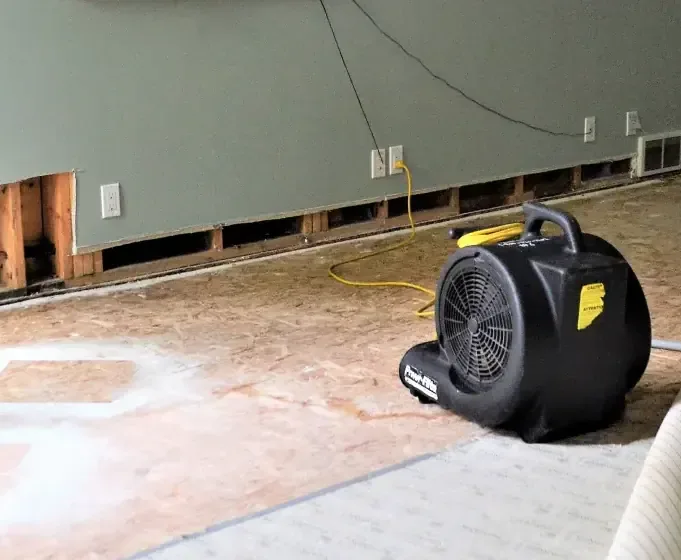
First steps for structural drying and dehumidification
Take baseline readings
Meters record dry reference points in unaffected rooms before wet readings are logged.
Remove what cannot dry
Pad, soaked insulation and swollen board come out so equipment works on recoverable material.
Place the equipment
Dehumidifiers and air movers are placed by room volume and wet area.
Read daily
Each visit checks the trend and moves equipment as materials reach dry goals.
How structural drying and dehumidification is handled
SCAG housing data puts 40.9 percent of local units at 1939 or earlier, 23.1 percent in the 1940s and 18.5 percent in the 1950s, so older framing and flooring are the norm to plan around. Old wood dries well when the process is steady and measured.
Rapid local response
Active water is treated as urgent at any hour, so the extraction crew starts while the water is still on the surface.
IICRC S500 drying standard
Moisture mapping comes first, then extraction, air movers and LGR dehumidifiers sized to the class of loss.
Claim-ready documentation
The mitigation team keeps a moisture map, daily psychrometric logs and timestamped photos for the adjuster.
Valley water know-how
Slab floors, copper under concrete, hard water and storm runoff with nowhere to drain shape each drying plan.
What does structural drying and dehumidification cost in San Marino, CA?
One or two rooms with a single dehumidifier typically cost $1,500 to $3,000. Several rooms or a slab run $3,000 to $5,500, and Class 4 materials such as hardwood, plaster or concrete can reach $5,500 to $8,000+.
One or two rooms
$1,500 to $3,000- Air movers and one dehumidifier
- Daily readings
- Three to four days
Several rooms or a slab
$3,000 to $5,500- LGR dehumidifiers and cavity drying
- Slab or subfloor drying
- Four to six days
Class 4 materials
$5,500 to $8,000+- Desiccant dehumidification
- Hardwood, plaster or concrete
- Extended monitoring
Ranges are typical, not a quote: the water category, square footage, material class and how fast drying started move the number most. The water damage cost calculator gives a closer planning range.
Structural Drying and Dehumidification, step by step
- 1
Map and measure
A meter and thermal camera chart the wet zone, and reference readings set each dry goal.
- 2
Open and expose
Wall bottoms and subfloor edges open where moisture is trapped, so air can reach it.
- 3
Dry on a schedule
Equipment runs nonstop while each visit adjusts placement and airflow.
- 4
Confirm and release
Readings at dry goals across every material let equipment leave and repairs begin.
How dry is measured
Drying is judged against reference readings from unaffected areas of the same house, not a guess. A moisture meter checks wood and drywall, a hygrometer tracks humidity and temperature, and a thermal camera spots cold, damp zones. Readings are taken in the same spots every visit so the trend is clear.
What the equipment does
LGR dehumidifiers pull water out of the air, so the wet materials give moisture back into it. Air movers keep that exchange going across surfaces, and angled units push dry air into cavities and under cabinets. Desiccant units come in for dense or cold materials. Equipment count follows the volume of wet material, not the square footage alone.
- Drywall dries fastest and is checked first
- Studs and joists take longer and set the end date
- Hardwood and concrete need slow, careful drying
Daily visits and the final record
Each visit logs temperature, humidity and moisture content, then moves equipment toward the wettest spots. When every material reads at its dry goal, the equipment goes and the log goes to the owner. The adjuster sees the same numbers the crew sees. Where the water first came from a burst pipe, burst pipe damage and water extraction sit upstream of this stage.
Structural drying and dehumidification coverage and nearby areas
Drying equipment goes into homes across ZIP codes 91108 and 91118, from the Old Town and Old Mill areas to the blocks around City Hall, Huntington Drive and the Crowell Public Library.
The same service nearby: structural drying and dehumidification in Sun Valley, San Gabriel, South Pasadena.
Related water damage services in San Marino
Structural Drying and Dehumidification: common questions
How do I know the structure is actually dry?
Meter readings in each material match those taken in an unaffected part of the same house, and the log shows several visits of steady numbers rather than one lucky reading.
Can fans alone dry a wet house?
Fans move air but cannot remove water from the air. Without dehumidifiers, humidity rises and moisture ends up back in the walls, so drying stalls.
Why do older homes dry differently?
Older lumber is dense and releases moisture slowly, and 40.9 percent of local units date to 1939 or earlier, so plans lean on steady low humidity rather than aggressive heat.
How loud is the equipment?
Dehumidifiers and air movers hum and blow constantly, so expect a steady drone for the length of the job. Equipment is placed to keep walkways clear and cords away from standing water.
Will drying raise the electric bill?
Yes, somewhat. Several machines run around the clock, and the log records how many ran and for how long, which is useful claim documentation.
When can repairs start?
When the readings reach the dry goal and the equipment is removed, so new drywall, flooring and paint do not seal in moisture. A cavity closed while damp can grow mold within 24 to 48 hours.
Dry the walls, not just the floor
A crew maps the moisture, sets equipment by room and visits daily until every material reaches its dry goal.